
In modern metallurgy and the foundry industry, high strength, toughness, thin-walled lightweighting, and low defect rates have become important indicators for measuring casting quality. Whether it is precision chassis parts for New Energy Vehicles (NEVs) or large-scale wind power hubs, the microstructure control of iron liquid dictates the performance of the final product. In this microscopic arrangement, efficient iron casting inoculants play a crucial role in promoting the formation of grain nuclei.
As an industry enterprise deeply rooted in the ferroalloy and metallurgical materials sector, Anyang Lishi Industrial Co., Ltd. (Lishi Metallurgy) always focuses on technological evolution. Combined with the technological development trends of the foundry industry in 2026, this article will analyze the microscopic mechanism and mainstream types of heterogeneous nucleation inoculating materials for iron liquid, guiding you on how to select a matching refined inoculation solution in a variable process environment.
I. Microscopic Mechanism of Heterogeneous Nucleation Inoculating Materials for Iron Liquid: Why Is It Essential?
During the solidification of gray iron and ductile iron, molten iron is prone to supercooling tendencies, leading to the precipitation of a hard and brittle "white iron structure" (cementite). This affects the machining performance of the castings and increases the risk of cracking.
By properly introducing high-performance inoculant alloy materials, fine, uniform, and stable heterogeneous nuclei can be introduced into the molten iron to:
-
Promote graphite precipitation: Effectively reduce the degree of undercooling, suppress the formation of white spots, and ensure that graphite precipitates uniformly in an ideal form (A-type graphite in gray iron, high nodularity graphite in ductile iron).
-
Refine grains and eutectic cells: Increase the number of eutectic cells and optimize the matrix structure (such as increasing pearlite content), thereby improving the tensile strength and toughness of castings without sacrificing plasticity.
-
Reduce section sensitivity: Uniformize the microstructure at uneven wall thicknesses, preventing hardening in thin sections and coarse structures in thick sections.
II. New Challenges Posed by 2026 Foundry Industry Development Trends on Casting Additives
As the global industry shifts toward digitalization and low-carbon transformation, the foundry industry in 2025-2026 exhibits several major trends that directly reshape buyers' quality demands for high-quality metallurgical inoculating materials:
-
Specialized Inoculants for Green, Low-Carbon Melting: Significantly Higher Purity Requirements With the popularization of Electric Arc Furnaces (EAF) and induction furnaces in green manufacturing, the recycling rate of scrap steel has increased. This results in more complex impurities and genetic characteristics in the base molten iron. Modern foundries require core additives to have high chemical purity, strictly limiting harmful impurities (such as excessive sulfur, phosphorus, and unstable gas elements) to prevent subcutaneous pores and slag inclusion defects in precision casting.
-
Rigorous Requirements for Long-Term Fading Resistance in Heavy-Section and Ultra-Thin Walled Castings
-
Wind Power & Heavy Machinery (Heavy Sections): Large wind power castings demand strong long-term anti-fading capabilities from the iron liquid. Because thick and large sections take a long time to solidify, conventional categories easily lose efficacy, requiring specialized anti-fading inoculants for heavy-section castings.
-
New Energy Vehicles (Ultra-Thin Walled Integrated Lightweighting): Automotive structural parts are evolving toward thin walls, demanding high iron liquid fluidity and instantaneous inoculation. This has driven the application demand for specialized composite inoculants for thin-walled NEV components (such as those containing bismuth Bi, strontium Sr, and barium Ba).
-
-
Standardized Application of Specialized Particles for Automated Stream Inoculation To reduce human error, modern casting production lines widely adopt automated feeding and stream inoculation systems. This requires the particle size distribution of the inoculant alloy to be precise and dust-free, otherwise it can easily clog pipelines or cause uneven inoculation.
III. Mainstream Iron Liquid Conditioning Alloy Categories and 2026 Application Selection
In the product matrix of Anyang Lishi Industrial, we provide diversified customized product series for different casting conditions :
-
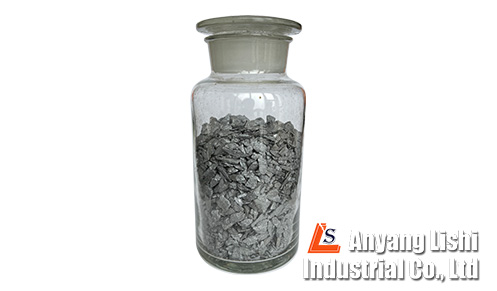
High-Quality Ferrosilicon-Based Inoculating Materials (FeSi Inoculant)
-
Core Elements: Si: 72-75%, with scientifically controlled Al and Ca content.
-
Application Scenarios: As a cost-effective and versatile choice, it is suitable for furnace inoculation of conventional gray iron and ductile iron. Its absorption rate is favorable, effectively eliminating the white-mouth tendency of castings with conventional wall thickness.
-
-
Long-Acting Anti-Fading Barium Inoculant (Si-Ba Inoculant)
-
Core Elements: Si base, complexed with 2-6% Ba and appropriate amounts of Ca and Al.
-
Application Scenarios: Features excellent anti-fading performance. The addition of barium slows down the inoculation fading rate, extending the anti-fading time to 20-30 minutes. In 2026, it is applied in large wind power hubs, heavy-section ductile iron parts, and intermittent pouring processes.
-
-
Deoxidizing and Modifying Calcium Inoculating Materials (Si-Ca Inoculant)
-
Core Elements: Si base, with Ca content within the 20-30% range.
-
Application Scenarios: Combines the dual benefits of strong deoxidation and improved fluidity. It possesses a strong capacity for deoxidation, desulfurization, and altering the morphology of inclusions. It is frequently used in high-performance pipe fittings and valve body casting, improving the mold-filling capability of low-carbon, low-silicon iron liquid.
-
-
Specialized Composite Inoculants for Thin-Walled Lightweight Components (Bi, Sr, RE Special Series)
-
Core Elements: High-purity ferrosilicon base, complexed with trace active elements (such as strontium, bismuth, or rare earths).
-
Application Scenarios: Suitable for precision and lightweight castings. For instance, strontium (Sr) effectively eliminates white mouth in thin-walled parts without increasing shrinkage defects caused by eutectic cells; bismuth (Bi) can explosively increase the graphite nodule count in ductile iron. It is mostly used in the production of automotive engine cylinder blocks and NEV chassis parts.
-
IV. Grain Size and Pouring Method Matching: Tailored Process Requirements
The effect of furnace inoculation treatment in casting depends not only on the chemical composition but also on the reasonable matching between the product grain size and the pouring method:
-
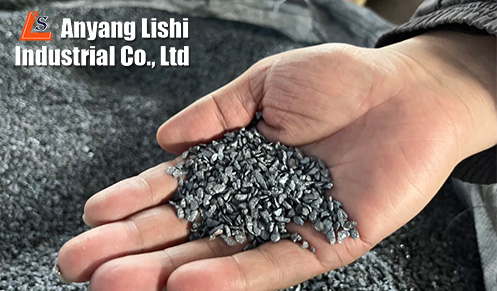
In-mold/Ladle Bottom Pouring Inoculation: Typically uses 3-8mm or 1-3mm particles. When the molten iron rushes into the ladle, this grain size achieves uniform and moderately paced dissolution, ensuring stable iron liquid quality throughout the ladle.
-
Automated Stream Inoculation (Stream Inoculation): Strict particle size requirements apply, with common specifications being 0.2-0.7mm or 0.2-0.5mm. Lishi Industrial utilizes classification screening technology to ensure that the specialized particles for automated stream inoculation are free of fine dust, do not clump, and exhibit good fluidity, adapting well to modern automated pouring machines.
V. Why Do Global Buyers Choose Anyang Lishi Industrial (Lishi Metallurgy)?
As a comprehensive ferroalloy enterprise integrating scientific research, manufacturing, and import/export trade, Anyang Lishi Industrial relies on industry accumulation to provide differentiated core value to global customers:
-
Long-Term Quality Accumulation: We have experienced several technological iterations in the foundry industry, understand the iron liquid conditioning methods under various complex working conditions, and have fully passed the ISO9001:2000 international quality management system certification.
-
Modernized In-House Laboratory: The company is equipped with testing equipment such as vacuum direct-reading spectrometers and microcomputer carbon-sulfur analyzers. Every batch of customized metallurgical inoculant solutions leaving the factory, from major elements (Si, Ba, Ca) to trace elements (Al, Ti), is strictly controlled to reduce batch fluctuations.
-
Flexible Customization Capability: Owning a 45,000-square-meter factory, we can provide not only Chinese national standard (GB) and American standard (ASTM) products but also customize corresponding chemical compositions and grain size ranges according to the customer's specific casting wall thickness and iron liquid ratio.
Conclusion & Call to Action (CTA)
In the casting process, details affect success or failure. Choosing high-quality, highly stable long-acting ductile/gray iron inoculating alloys not only helps you control casting defect rates but also enhances the market competitiveness of your end products.
If you are looking for special element composite inoculation additives that can improve anti-fading performance, reduce white-mouth defects, or match automated stream systems, please visit our official product page:Anyang Lishi Industrial Inoculant Zone.
-
Contact our Metallurgical Experts: Get product quotes, detailed Technical Data Sheets (TDS), and sample testing.
-
Service Hotline: +86 15837207537
-
Official Email: info@lsalloy.com